On Thursday 8th December from 10 until 2, people are invited to come to 14 George’s Need, TA1 2LX to sign supportive greetings cards to 3 prisoners of conscience, chosen from 10 in the Write for Rights booklet produced annually by Amnesty UK. We are supporting Aleksandra Skochilemko in jail in Russia for opposing the Ukraine invasion, Shahnawaz Chowdhury a Bangladeshi environmentalist facing jail for posting an opinion on Facebook and Dorgelesse Nguessan from Cameroon in prison for attending her first peaceful demonstration.
Mince pies and homemade cake, tea and coffee offered as reward for good deeds!
We will also have a Write for Rights stall in St Mary Magdalene Church this Saturday (10th December) from 10am until 1.45pm, and there is a lunchtime concert from 12.30pm to 1.30pm. Please pop along!
Cherry Bird, AIUK’s Country Co-ordinator for South East Asia, gave a talk on Sri Lanka, a once peaceful and prosperous country now mired in conflict. For decades there have been tensions between the majority Sinhalese, Buddhist population and the Tamil minority who are mainly Hindu. The Tamils are poorer and have felt excluded – remember the Tamil Tigers?
The Civil War lasted for 25 years, with a draconian Prevention of Terrorism Act enacted in 1979. Amnesty is concerned at the very high number of disappearances – estimated at 60,000. More recently the country has been ruled, in turn, by the Rajapaska brothers, described as muscular populists. Their time has now passed (one has fled the country) and a new president elected – Ramil Wickremesinghe. He has a lot to sort out.
Cherry reminded us that there’s a Regional Conference in Exeter next March – details to follow.
Members updated the meeting on appeals for a number of political prisoners, most prominently Alaa Abdul Fattah, imprisoned in Egypt and on prolonged hunger strike which has come to a head during the COP 27 conference. His fate is still uncertain.
As usual our own country co-ordinator for the Middle East and North Africa had been busy: she has written for Moroccan Rida Benotmane, charged with putting up critical Facebook posts. Another Moroccan, Fatimah Kassim is in solitary confinement and has now gone on hunger strike. Mohammed Ben Lima of Algeria has been sentenced to death in absentia, but is now being extradited by Spain.
Cherry made the point that writing to Embassies is an effective way of communicating. Amnesty’s programme on Kashmir is about to be re-launched. What pressure can be brought to bear on India for their human rights violations in the area? The UK has trade agreements with them.
Write for Rights
November/December bring us round to Amnesty’s annual letter writing campaign, Write for Rights. We will have a stall in St Mary Magdalene Church in the town centre from 10am-2pm on Saturday 10 December, which, most appropriately, is Human Rights Day. We will break from 12.30 to 1.30 when the church has a lunchtime concert, Opera Muses.
There’ll be no other December meeting – it would be good to see you on Saturday 10 December, when we’ll have information about this year’s Write for Rights cases. Come along and write a card to a prisoner of conscience.
Next meeting at the Quaker Meeting House will be Tuesday 10 Jan at 7.30pm.
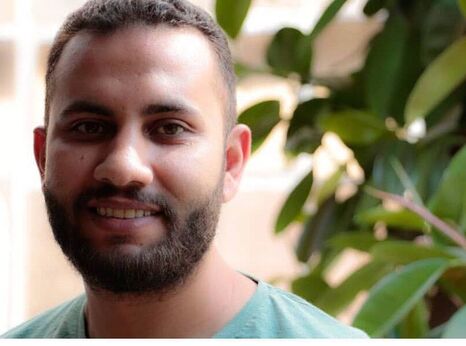
Taunton Amnesty Group have taken on the case of Ibrahim Ezz el-Din, a young Egyptian researcher specialising in housing at the Egyptian Commission for Rights and Freedom. He was arrested in June 2019 and was ‘disappeared’ for 167 days until November 2019. He alleged he had been tortured. Charges were made with no evidence and in January 2021 a judge decided to release him. He was sent to a police station awaiting release where he was interviewed by the state security force (NSA) who decided to charge him with new offences. He is back in prison. This pattern is common in Egypt. He had twice attempted suicide but has been refused medical help.
Our first action as a group is to attempt a 3-month blitz of letters, each volunteer agreeing to write a letter (rather than an email), on the same day each month, for 3 months (3 letters in all). WOULD YOU HELP US? We would like to cover every day of the month with a letter. Please click here for more details or contact us at amnestytaunton@gmail.com
We met in person for our AGM. Our Chair reported on another year shaped by the pandemic. However, he reflected that we had nonetheless managed to host a number of speakers on a good variety of topics: the Calais Jungle, Women living under Muslim Law, the Human Rights Act. There were some notable initiatives, for example contacts with Taunton Town Football Club who joined forces with members of Amnesty Taunton to raise awareness about refugees.
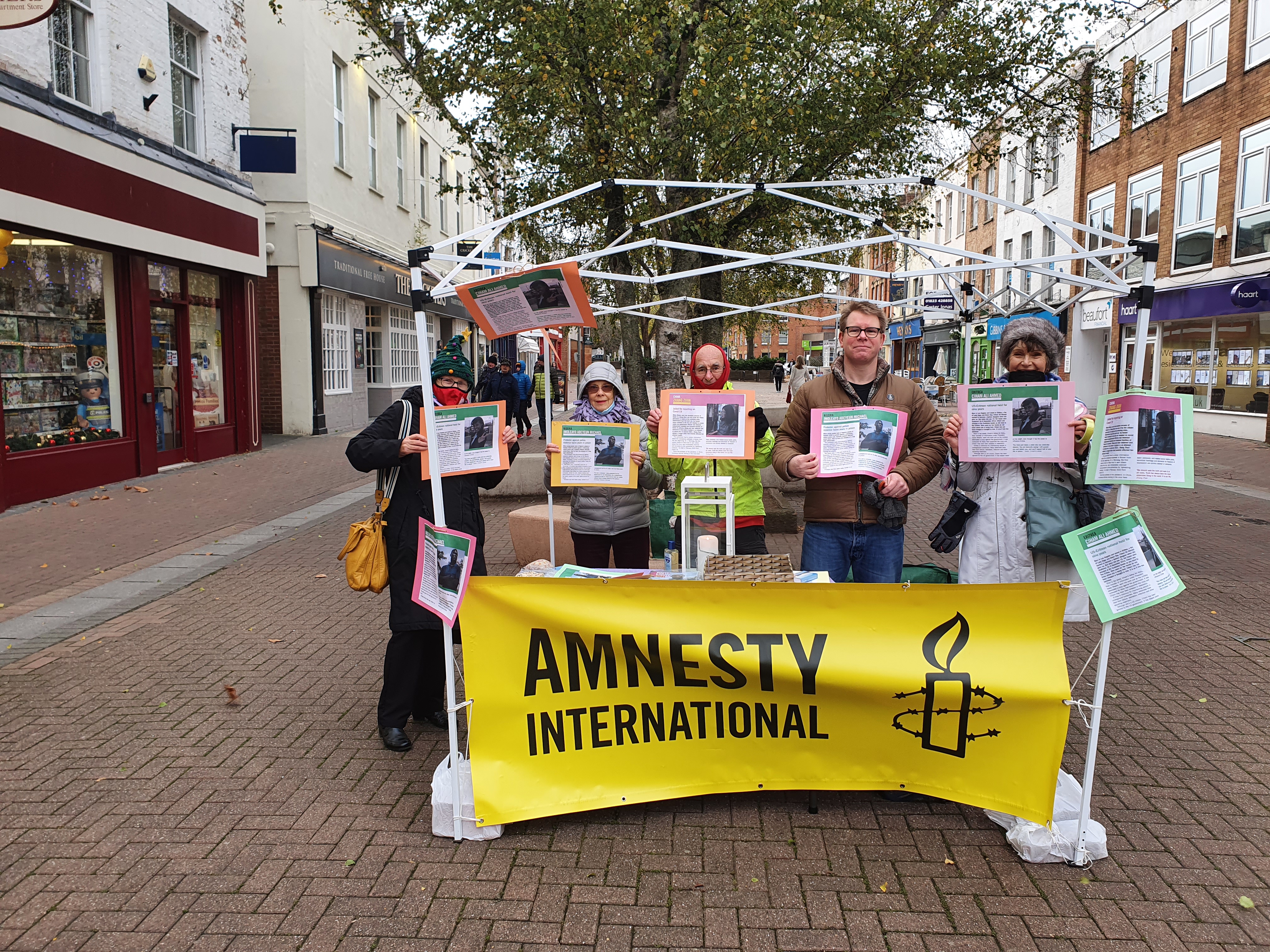
Write for Rights was marked by resilient members of the Group running a stall in Taunton High Street during Storm Arwen – we have a photo taken after the gazebo cover had blown away!
No meaningful fund-raising has been possible during the pandemic and it has been hard to get publicity in the local press, which appears (due to its own pressures admittedly) to have given up on reporting on the activities of local groups.
We had a full Agenda for our regular meeting. After intensive research and legal analysis Amnesty has launched a new campaign to highlight Israel’s ‘crime against humanity of apartheid in its treatment of Palestinians’: ‘Demolish Apartheid, not Palestinian Homes.’
A new online action is planned against the Nationality and Borders Bill. ‘Amongst the many other areas of concern, the Bill seeks to largely shut down the UK’s asylum system and criminalise and punish refugees.’
A new activist-led campaign on Human Rights in Afghanistan is being launched; one particular aim is to ensure that Afghan women’s rights remain in the public eye.
The Human Rights Act is under threat; the Government has launched a consultation and invites public comment. Amnesty is anxious its members should voice their views, and will shortly have a link on its website. Links to all the above topics (and many others) are also available amnesty.org.uk
A steady stream of Urgent Actions for North Africa continues. As a group we are focusing on one particular case, Ibrahim Ezz El-Din, with the aim of blitzing the Egyptian authorities with letters, underlining that they are breaking their own laws in this detention.
Our next meeting will be on Tuesday 8 March at 7.30pm in the Quaker Meeting House, Taunton.
A landmark meeting – after 18 months we dared to meet in person, and it did give a much better feeling than Zoom or Teams!
Aser Mohamed, then a child of 14, was first arrested, tortured and imprisoned in 2016 in Egypt. He has since been sentenced to 10 years for membership of the banned Muslim Brotherhood. We asked for his immediate release and an investigation into his treatment. We signed letters and created doves of peace to send on his behalf to the Egyptian Ambassador to London, and to President Al Sisi of Egypt.
The general situation in Egypt remains threatening. 12 men are facing the death penalty for actions in 2013; women influencers are being convicted and sentenced to lengthy prison terms. However a major piece of good news is that all charges against Human Rights lawyer Azza Soliman have been dropped, and her travel ban lifted.
We discussed the dangerous situation in Afghanistan, and how to mobilise opinion and effective action from the UK Government in rescuing and giving sanctuary to Afghans in danger.
In India there have been no developments in the BK16 human rights defenders, but a heartening message has come to the mid-Devon group from one of them, Vernon Gonsalves, a 61 year old writer, professor and trade union activist:
“Heartfelt thanks for the cards and letters of solidarity you have been sending. Words are indeed powerful means of support – and don’t we all need support always – though I must say we have never, through these 3 years, been allowed to feel alone. It’s persons like you who keep reminding us that the path towards justice may be long, but won’t be lonely.”
The 3 part ITV series on the Stephen Lawrence case was recommended – ‘Stephen’, a drama about Doreen and Neville Lawrence’s crusade to achieve justice for their son.
We meet on the second Tuesday of the month at 7.30pm in the Friends Meeting House in Bath Place – visitors always welcome. Email: amnestytaunton@gmail.com for further details. Follow us too on Facebook and at amnestytaunton.com
14 to 20 June is Refugee Week, looking at the plight of refugees world wide. Its theme is ‘You cannot walk alone’, remembering Martin Luther King’s ‘I have a dream’ speech of 1963.
Amnesty are highlighting a few of its many aspects, continuing ‘Football Welcomes’, something we have been discussing here in Taunton. On World Refugee Day, 20 June, there will be a vigil outside the Danish Embassy in London protesting against Denmark’s plan to deport refugees from Syria back to Damascus, where they will be at high risk of arrest and torture. We were asked to write messages in support.
An ever-present stain on the world’s conscience is what has happened to Rohingya refugees who have fled from Myanmar (Burma) to Bangladesh. We were asked to sign a petition urging the Bangladesh Government to ‘protect, respect and fulfill their rights’ and ensure their participation in the decisions that affect them.
Our North Africa co-ordinator has been writing letters on behalf of journalists, lawyers and other human right supporters in Egypt and Morocco, countries which stand out for their disregard of human rights. Our India co-ordinator reported on online actions taking place via Twitter last weekend for the BK16 prisoners of conscience.
We were asked to put pressure on the US after the ceasefire between Israel and the Palestinian Territories. ‘As Israel’s closest ally, the US has a responsibility to pressure Israel to end and redress its systematic violations against Palestinians’.
Five of our members took part in the ‘Kill the Bill’ vigil on 5 June, to protest about the proposed powers to be given to the police under the planned Police Crime Courts and Sentencing bill, which it is feared will aim to silence protest.
Our Books of the Month are by human rights lawyer Philippe Sands – East West Street and The Ratline.
Our next online meeting is at 7.30pm on Tuesday 13 July – all are welcome. Email amnestytaunton@gmail.com for details.
The Overseas Operations Bill that the government is attempting to pass is a cause for concern. It would decriminalise torture and war crimes, and could make it even harder to prosecute cases committed by British soldiers more than five years ago. It has been described as an attempt to put the military above the law.
Read Amnesty’s blog ‘Five things you need to know about the Overseas Operations Bill’ here and sign the online petition demanding that the government does not decriminalise war crimes and torture.
Our meeting was as usual a virtual one. We meet on the second Tuesday of the month at 7.30pm. Newcomers are always welcome – you’ll find joining instructions on our website, amnestytaunton.com.
Our November meeting heard reports on the Death Penalty; it seems probable that, with an incoming Democratic President in the US, Federal executions will cease. Some members were planning to take part in a Twitterstorm, bombarding the Egyptian authorities with tweets on the birthday of Ibrahim Ezz El-Din who turned 28 on Sunday 15 November 2020. By then he will have been in prison in Egypt for 17 months simply for standing up for housing rights.
Amnesty’s work in India has had to cease because AI India’s bank accounts have been suspended by the authorities. Julie Verhaar, Acting General Secretary of AI said:
“This is an egregious and shameful act by the Indian Government, which forces us to cease the crucial human rights work of Amnesty International India for now. However, this does not mark the end of our firm commitment to, and engagement in, the struggle for human rights in India. We will be working resolutely to determine how Amnesty International can continue to play our part within the human rights movement in India for years to come.”
This is the time of year that Amnesty holds its Write for Rights events, but things will be a little different this year. However, we are still sending a card, email or tweet of support to ten individuals or groups of people whose freedoms are being denied, and writing to those in power to challenge their actions.
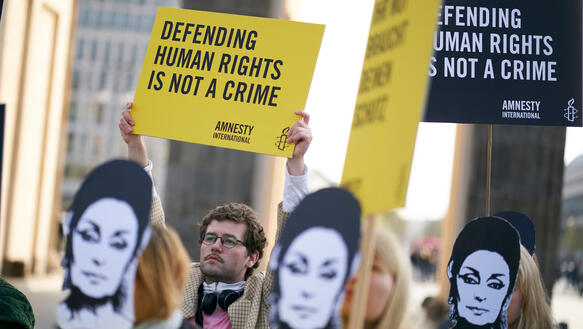
We will be holding a Vigil in Taunton town centre on 12 December from 10-11am, focussing particularly on the case of Nasrin Sotoudeh, a human rights lawyer sentenced to a horrific 38 years imprisonment and 148 lashes. Write for Rightsmaterials and advice will be available at the vigil. Please join us – we will be standing near the Tourist Information Office at the bottom of the High Street. Please wear a mask and we will maintain 2m social distancing. If you want to find out about Nasrin in advance – here is a link. https://www.amnesty.org.uk/actions/free-nasrin-sotoudeh
Our September meeting was as usual a virtual one. Our speaker was Cherry Bird, the AI UK South West Regional representative. She spoke of how Amnesty has changed to keep abreast of the mood and demands of the times. AI UK’s AGM later this month is a virtual one.
There is more emphasis on actions for human rights and prisoners of conscience than letter writing, and greater use of social media. Vigils are a useful tool for consciousness raising. Amnesty is keen to engage younger members – they have a Student Action network group – and to keep them engaged. Where are those past members of University Groups?
But letter writing is still an essential tool. For our actions this month we wrote to the Cambodianauthorities on behalf of Wanchalearm Satsaksit, a Thai activist in exile, who has reportedly been abducted from Cambodia where he was living. Nine such activists have been abducted in recent years; two of them are known to be dead.
We emailed the Turkish authorities on behalf of Eren Keskin, a brave and principled human rights lawyer. She has faced repeated harassment over the years, and is now in danger of imprisonment.
We heard reports from members on the Death Penalty, the Middle East and North Africa, India and Amnesty Feminists, working on issues involving women. We heard again of the appalling case of Nasrin Soutedeh, Iranian human rights lawyer, sentenced last year to a 38 year term and 148 lashes; she is currently on hunger strike. Letters were written on behalf of Egyptian human rights lawyer, Hoda Abdel Moneim, held for many months in pre-trial detention, and Moroccan journalist Omar Radi, harassed for his political investigations.
Our Book of the Month is Somerset Executions by A M Gould – ‘If history were told in the form of stories it would never be forgotten’ wrote Kipling, and this book is a case in point.
We meet online at 7.30pm on the second Tuesday of each month, and all are welcome. Email amnestytaunton@gmail.com if you would like details of how to join the meeting.
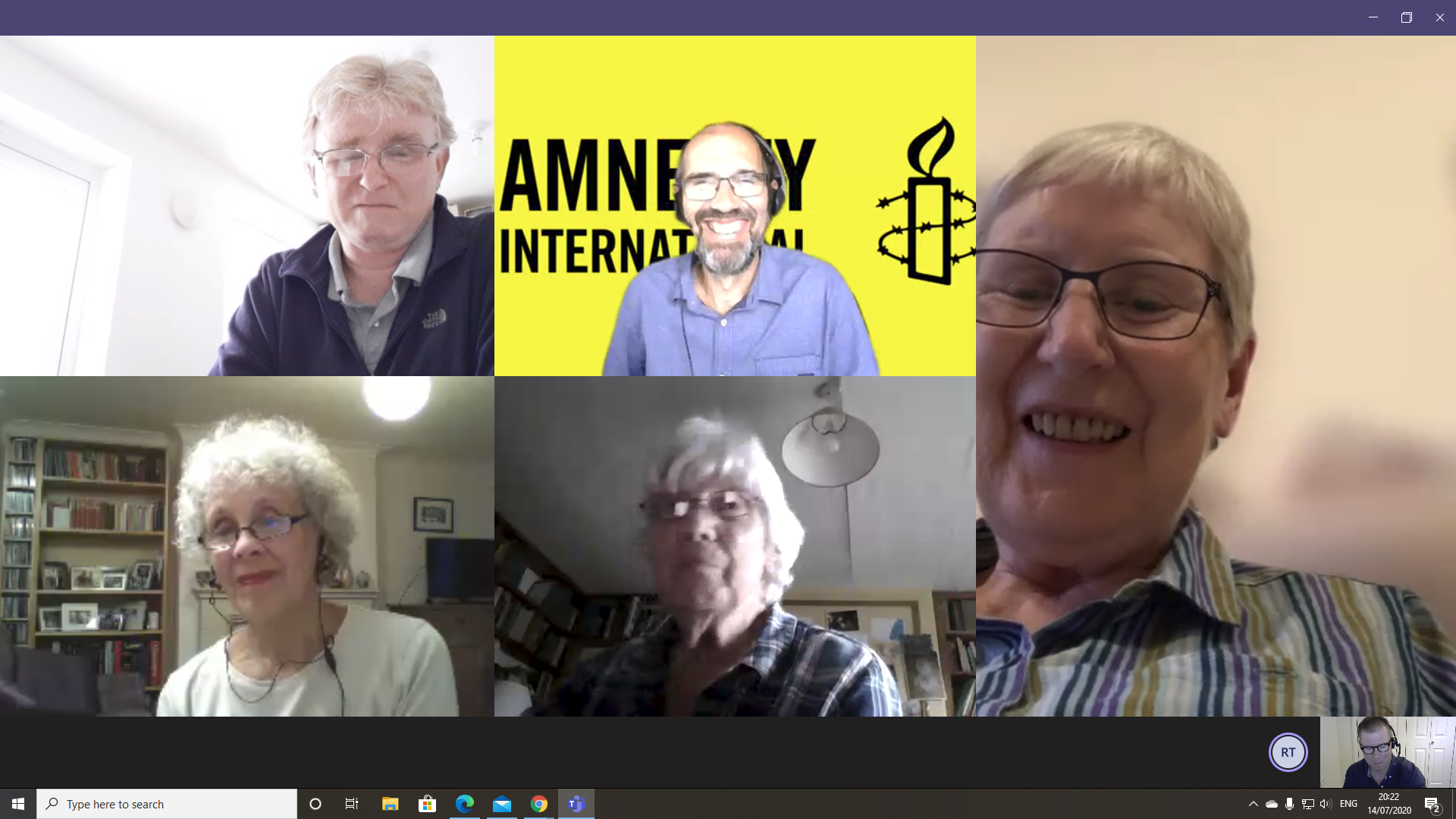
Our July meeting was held virtually – the new normal! We were joined by Helen Clarke of AIUK, Country Coordinator for Turkey, to describe her work, which is to keep abreast of all that is going on in Turkey from a Human Rights point of view and translate this into information and action.
She outlined some current cases in Turkey: Taner Kilic, the ex-head of AI Turkey was sentenced this month to 6 years in prison; Eren Kiskin, another human rights activist, one of Amnesty’s Individuals at Risk, threatened and victimized; writer Ahmet Altan who had emerged from prison after a sentence of some years, only to be re-arrested the following day on a different charge and returned to prison.
This month’s actions are all online. We were asked to sign appeals on a variety of subjects: a call for social media companies to show more restraint and sensitivity in the images they show of violent events; an appeal for urgent care for dual British-Iranian national Anoosheh Ashoori serving a lengthy prison sentence after a grossly unfair trial, and an appeal to Russia to vote at the Security Council for renewal of vital cross-border aid for refugees in north-west Syria.
We heard reports from members of work on India, Egypt and the death penalty. Member Ben Grant had had a discussion with Taunton MP Rebecca Pow focusing on the Families Together campaign, and pointing out the contradictions in the Government’s position on child refugees.
Our Book of the Month is No Friend but the Mountains: Writing from Manus prison by Behrouz Boochani, a Kurdish-Iranian journalist asylum seeker imprisoned for 4 years on Christmas Island by the Australian Government.
Our next regular meeting (still virtual) will be at 7.30pm on Tuesday 8 September. Email amnestytaunton@gmail.com if you’d like to join us.




 Our July meeting was held virtually – the new normal! We were joined by Helen Clarke of AIUK, Country Coordinator for Turkey, to describe her work, which is to keep abreast of all that is going on in Turkey from a Human Rights point of view and translate this into information and action.

