
 Our July meeting was held virtually – the new normal! We were joined by Helen Clarke of AIUK, Country Coordinator for Turkey, to describe her work, which is to keep abreast of all that is going on in Turkey from a Human Rights point of view and translate this into information and action.
She outlined some current cases in Turkey: Taner Kilic, the ex-head of AI Turkey was sentenced this month to 6 years in prison; Eren Kiskin, another human rights activist, one of Amnesty’s Individuals at Risk, threatened and victimized; writer Ahmet Altan who had emerged from prison after a sentence of some years, only to be re-arrested the following day on a different charge and returned to prison.
This month’s actions are all online. We were asked to sign appeals on a variety of subjects: a call for social media companies to show more restraint and sensitivity in the images they show of violent events; an appeal for urgent care for dual British-Iranian national Anoosheh Ashoori serving a lengthy prison sentence after a grossly unfair trial, and an appeal to Russia to vote at the Security Council for renewal of vital cross-border aid for refugees in north-west Syria.
We heard reports from members of work on India, Egypt and the death penalty. Member Ben Grant had had a discussion with Taunton MP Rebecca Pow focusing on the Families Together campaign, and pointing out the contradictions in the Government’s position on child refugees.
Our Book of the Month is No Friend but the Mountains: Writing from Manus prison by Behrouz Boochani, a Kurdish-Iranian journalist asylum seeker imprisoned for 4 years on Christmas Island by the Australian Government.
Our next regular meeting (still virtual) will be at 7.30pm on Tuesday 8 September. Email amnestytaunton@gmail.com if you’d like to join us.
 This month’s action was for Pakistani human rights defender and researcher Muhammad Idris Khattak (pictured) who was ‘disappeared’ in November 2019. Nothing has been heard of him since, and his family is extremely concerned for his well-being – he is a diabetic needing daily medication, and at risk of course from Covid-19. The disappeared are at risk of torture and even death. If they are released, the physical and psychological scars endure. Disappearances are a tool of terror that strikes not just individuals or families, but entire societies. Enforced disappearance is a crime under international law and, if committed as part of a widespread or systematic attack, they constitute a crime against humanity. We emailed Pakistan’s Prime Minister Imran Khan on his behalf; his government promised to criminalise enforced disappearances, but nothing has been done.
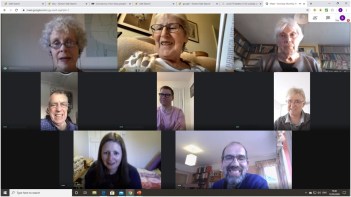 In tune with the times we held our second online virtual meeting this month, and followed up several Monthly Actions, influenced by the current crisis.
 Despite the current lockdown measures we were able to hold a virtual meeting from our own homes, and, thanks to the system set up, managed to communicate successfully.
 ular risk from Covid-19: women who are victims of domestic abuse, refugees and migrants, and, crucially, essential workers who need proper support and protective equipment.
 Self isolation. Funny, isn’t it, how the expression has quickly become part of our everyday language?
 Our next meeting is at 7.30pm on Tuesday 10 March at the Quaker Meeting Rooms, Bath Place, Taunton. It will include a workshop on Amnesty and Climate Change led by our Amnesty Trainer Susan Mew.
 Yesterday, Taunton Amnesty Group donated several children’s books about refugees to the Taunton Library (pictured). This donation accompanies a small display at the library to highlight the Families Together campaign.
 mean many are prevented from being joined by their parents, brothers and sisters. These restrictive rules leave people isolated, traumatised and alone in the UK, knowing that the people they love still face untold dangers in other countries.

 Amnesty International Taunton Local Group