The Overseas Operations Bill that the government is attempting to pass is a cause for concern. It would decriminalise torture and war crimes, and could make it even harder to prosecute cases committed by British soldiers more than five years ago. It has been described as an attempt to put the military above the law.
Read Amnesty’s blog ‘Five things you need to know about the Overseas Operations Bill’ here and sign the online petition demanding that the government does not decriminalise war crimes and torture.
Our meeting was as usual a virtual one. We meet on the second Tuesday of the month at 7.30pm. Newcomers are always welcome – you’ll find joining instructions on our website, amnestytaunton.com.
Our November meeting heard reports on the Death Penalty; it seems probable that, with an incoming Democratic President in the US, Federal executions will cease. Some members were planning to take part in a Twitterstorm, bombarding the Egyptian authorities with tweets on the birthday of Ibrahim Ezz El-Din who turned 28 on Sunday 15 November 2020. By then he will have been in prison in Egypt for 17 months simply for standing up for housing rights.
Amnesty’s work in India has had to cease because AI India’s bank accounts have been suspended by the authorities. Julie Verhaar, Acting General Secretary of AI said:
“This is an egregious and shameful act by the Indian Government, which forces us to cease the crucial human rights work of Amnesty International India for now. However, this does not mark the end of our firm commitment to, and engagement in, the struggle for human rights in India. We will be working resolutely to determine how Amnesty International can continue to play our part within the human rights movement in India for years to come.”
This is the time of year that Amnesty holds its Write for Rights events, but things will be a little different this year. However, we are still sending a card, email or tweet of support to ten individuals or groups of people whose freedoms are being denied, and writing to those in power to challenge their actions.
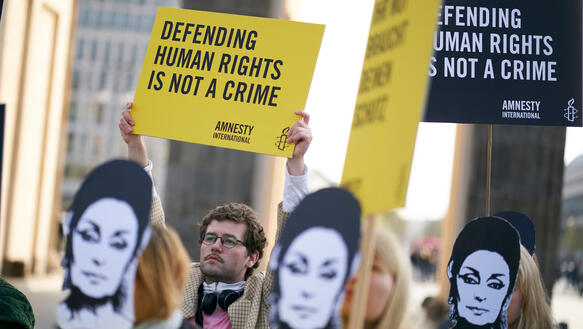
We will be holding a Vigil in Taunton town centre on 12 December from 10-11am, focussing particularly on the case of Nasrin Sotoudeh, a human rights lawyer sentenced to a horrific 38 years imprisonment and 148 lashes. Write for Rightsmaterials and advice will be available at the vigil. Please join us – we will be standing near the Tourist Information Office at the bottom of the High Street. Please wear a mask and we will maintain 2m social distancing. If you want to find out about Nasrin in advance – here is a link. https://www.amnesty.org.uk/actions/free-nasrin-sotoudeh
Our September meeting was as usual a virtual one. Our speaker was Cherry Bird, the AI UK South West Regional representative. She spoke of how Amnesty has changed to keep abreast of the mood and demands of the times. AI UK’s AGM later this month is a virtual one.
There is more emphasis on actions for human rights and prisoners of conscience than letter writing, and greater use of social media. Vigils are a useful tool for consciousness raising. Amnesty is keen to engage younger members – they have a Student Action network group – and to keep them engaged. Where are those past members of University Groups?
But letter writing is still an essential tool. For our actions this month we wrote to the Cambodianauthorities on behalf of Wanchalearm Satsaksit, a Thai activist in exile, who has reportedly been abducted from Cambodia where he was living. Nine such activists have been abducted in recent years; two of them are known to be dead.
We emailed the Turkish authorities on behalf of Eren Keskin, a brave and principled human rights lawyer. She has faced repeated harassment over the years, and is now in danger of imprisonment.
We heard reports from members on the Death Penalty, the Middle East and North Africa, India and Amnesty Feminists, working on issues involving women. We heard again of the appalling case of Nasrin Soutedeh, Iranian human rights lawyer, sentenced last year to a 38 year term and 148 lashes; she is currently on hunger strike. Letters were written on behalf of Egyptian human rights lawyer, Hoda Abdel Moneim, held for many months in pre-trial detention, and Moroccan journalist Omar Radi, harassed for his political investigations.
Our Book of the Month is Somerset Executions by A M Gould – ‘If history were told in the form of stories it would never be forgotten’ wrote Kipling, and this book is a case in point.
We meet online at 7.30pm on the second Tuesday of each month, and all are welcome. Email amnestytaunton@gmail.com if you would like details of how to join the meeting.
Our July meeting was held virtually – the new normal! We were joined by Helen Clarke of AIUK, Country Coordinator for Turkey, to describe her work, which is to keep abreast of all that is going on in Turkey from a Human Rights point of view and translate this into information and action.
She outlined some current cases in Turkey: Taner Kilic, the ex-head of AI Turkey was sentenced this month to 6 years in prison; Eren Kiskin, another human rights activist, one of Amnesty’s Individuals at Risk, threatened and victimized; writer Ahmet Altan who had emerged from prison after a sentence of some years, only to be re-arrested the following day on a different charge and returned to prison.
This month’s actions are all online. We were asked to sign appeals on a variety of subjects: a call for social media companies to show more restraint and sensitivity in the images they show of violent events; an appeal for urgent care for dual British-Iranian national Anoosheh Ashoori serving a lengthy prison sentence after a grossly unfair trial, and an appeal to Russia to vote at the Security Council for renewal of vital cross-border aid for refugees in north-west Syria.
We heard reports from members of work on India, Egypt and the death penalty. Member Ben Grant had had a discussion with Taunton MP Rebecca Pow focusing on the Families Together campaign, and pointing out the contradictions in the Government’s position on child refugees.
Our Book of the Month is No Friend but the Mountains: Writing from Manus prison by Behrouz Boochani, a Kurdish-Iranian journalist asylum seeker imprisoned for 4 years on Christmas Island by the Australian Government.
Our next regular meeting (still virtual) will be at 7.30pm on Tuesday 8 September. Email amnestytaunton@gmail.com if you’d like to join us.
As with so many of us at present, all our actions and meetings have been at a distance. Our June meeting was again a virtual one.
This month’s action was for Pakistani human rights defenderand researcherMuhammad Idris Khattak (pictured) who was ‘disappeared’ in November 2019. Nothing has been heard of him since, and his family is extremely concerned for his well-being – he is a diabetic needing daily medication, and at risk of course from Covid-19. The disappeared are at risk of torture and even death. If they are released, the physical and psychological scars endure. Disappearances are a tool of terror that strikes not just individuals or families, but entire societies. Enforced disappearance is a crime under international law and, if committed as part of a widespread or systematic attack, they constitute a crime against humanity. We emailed Pakistan’s Prime Minister Imran Khan on his behalf; his government promised to criminalise enforced disappearances, but nothing has been done.
We were asked to sign petitions highlighting the 120% increase in reports of domestic abuse under lockdown; the difficulty accessing abortion under lockdown for women in Northern Ireland, and the gross 38 year sentence and 148 lashes imposed on Iranian human rights lawyer Nasrin Sotoudeh for her work defending women’s human rights.
We heard reports on the Middle East and North Africa, the Death Penalty and India, and discussed the Black Lives Matter protests.
Our Book of the Month is Ratline: Love, Lies and Justice on the Trail of a Nazi Fugitive by human rights lawyer Philippe Sands.
Our next meeting will be a virtual one on14 July at 7.30pm; Helen Clarke of AIUK will talk on the human rights situation in Turkey. Email amnestytaunton@gmail.com if you would like to join us.
Refugee Week is a time when we can all celebrate the contribution refugees make to the UK. The theme of this year’s event is ‘Imagine’, and most activities will take place online this year.
To find out how you can take part, have a look on theRefugee Week website. There are films to watch, writing workshops, book launches, virtual exhibition tours and much more.
In tune with the times we held our second online virtual meeting this month, and followed up several Monthly Actions, influenced by the current crisis.
Covid-19 is exacerbating a domestic abuse crisis in the UK. Lockdown has seen a huge surge in calls (up 120%) to domestic abuse services and a reported increase in domestic abuse killings. We wrote letters and signed a petition on the Government’s duty to protect all its citizens as the Domestic Abuse Bill passes through Parliament.
We discussed and resolved to write letters on the case of Russian journalist Elena Milashina, who has received death threats from Chechnya’s leader Ramzan Kadyrov after publishing an article about the spread of Covid-19 in Chechnya.
In India the crackdown on dissidents continues. Meeran Haider, Shifa-Ur-Rehman and Safoora Zargar, who is three months pregnant, have been arrested for peacefully protesting the Citizenship Amendment Act (CAA), a law that legitimises discrimination on the basis of religion and stands in clear violation of the Constitution of India and international human rights law. Detained under the repressive Unlawful Activities Prevention Act (UAPA), the three can be held without charge for up to 180 days or even more, a duration far exceeding international standards. We were urged to write on their behalf to the Minister of Home Affairs.
We listened to detailed reports on the Middle East and North Africa (Ali Aarrass of Morocco has finally been released after 12 years) and on the Death Penalty.
The Death Penalty file makes wretched, depressing reading. We were asked to email on behalf of Hew Yoo Wah of Malaysia, arrested at the age of 20 for drugs offences, and awaiting execution 14 years later. Likewise for Billy Joe Wardlow of Texas, arrested for murder at the age of 18, and still on death row 27 years later.
Our next meeting is on Tuesday 9 June and will also be online. If you would like to join us, please email amnestytaunton@gmail.com for details.
Despite the current lockdown measures we were able to hold a virtual meeting from our own homes, and, thanks to the system set up, managed to communicate successfully.
Amnesty UK have suggested a number of supportive remote actions we could take. Solidarity is at the heart of much of what Amnesty does, and they are calling for our support in getting the Government to protect those at particular risk from Covid-19: women who are victims of domestic abuse, refugees and migrants, and, crucially, essential workers who need proper support and protective equipment.
Ben Grant gave a presentation on “Families Together”, based on the exhibition in Taunton Library (illustrated with drawings by children from Parkfield School), based on the premise that Refugee Children should be allowed to sponsor their families to join them in the UK. In 2018 a Bill to achieve this was passed by a resounding majority of 131; Taunton’s MP, Rebecca Pow, took part but, sadly, filibustered against it. The Bill was lost in the Brexit manoeuverings, but there is now a simple Bill to rectify the position in the House of Lords. The UK’s current position is in contravention of international law.
We heard reports on the Middle East and North Africa, the Death Penalty and Amnesty Feminists.
Alun gave a report on India; the BK9 (9 activists fighting for the rights of the poorest and most marginalised communities in the country) have become the BK11; letters and emails have been written to the authorities on their behalf.
Driven by events, “La Peste” by Albert Camus was chosen as Book of the Month. Many have interpreted it as an allegorical representation of French Resistance to Nazi occupation in WW2; today we may have another take on it – surely the hallmark of a great work of art.
Our next meeting is at 7.30pm on Tuesday 12 May via video link. If you would like to join us, please email amnestytaunton@gmail.com
Self isolation. Funny, isn’t it, how the expression has quickly become part of our everyday language?
But the isolation we, as Amnesty members, read about is of a different order. This is not isolation for the good of the community, with free access to our friends and family by phone, text, email, Facebook and Whatsapp. It is isolation in unsanitary conditions, with poor or little food, often with a ration of torture and no access to lawyers, doctors, friends or family.
So, while you – our supporters and followers out there – are coping with isolation, might you be able to go to the Amnesty UK website to read about Human Rights Defenders?
There are 3 cases you could help with: the Bhima Koregaon 9 (BK9) in India, jailed for fighting for the rights of the poorest in the country; three women in Iran facing 42 years in prison for unveiling; and the women in Saudi Arabia who, having campaigned for the right to drive – a right that has now been granted by the Saudi Government – find themselves in prison.
You won’t need to write a letter. It is difficult to obtain the correct postage now, so please email or sign the petitions!
Our next meeting is at 7.30pm on Tuesday 10 March at the Quaker Meeting Rooms, Bath Place, Taunton. It will include a workshop on Amnesty and Climate Change led by our Amnesty Trainer Susan Mew.


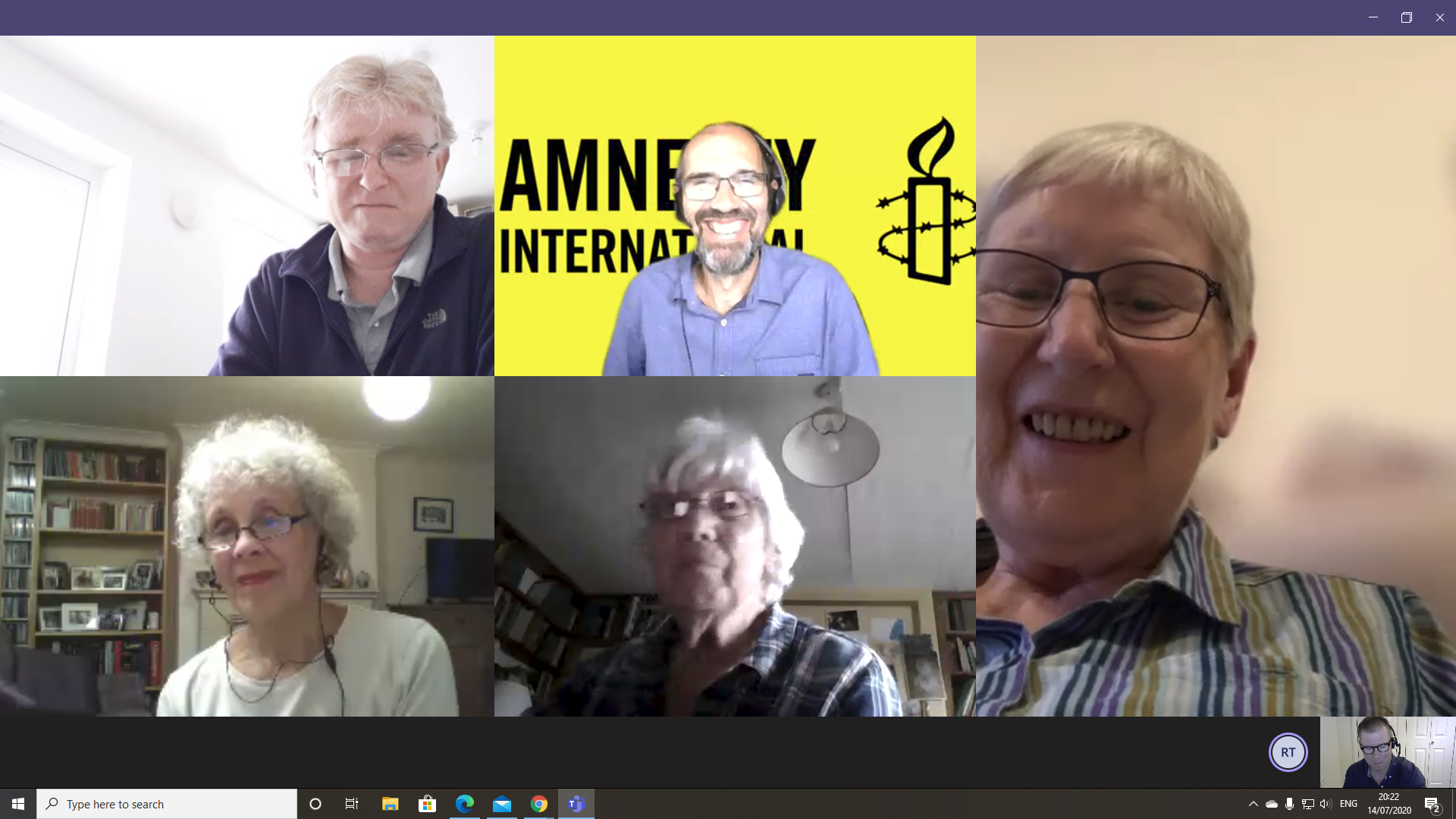 Our July meeting was held virtually – the new normal! We were joined by Helen Clarke of AIUK, Country Coordinator for Turkey, to describe her work, which is to keep abreast of all that is going on in Turkey from a Human Rights point of view and translate this into information and action.
 This month’s action was for Pakistani human rights defender and researcher Muhammad Idris Khattak (pictured) who was ‘disappeared’ in November 2019. Nothing has been heard of him since, and his family is extremely concerned for his well-being – he is a diabetic needing daily medication, and at risk of course from Covid-19. The disappeared are at risk of torture and even death. If they are released, the physical and psychological scars endure. Disappearances are a tool of terror that strikes not just individuals or families, but entire societies. Enforced disappearance is a crime under international law and, if committed as part of a widespread or systematic attack, they constitute a crime against humanity. We emailed Pakistan’s Prime Minister Imran Khan on his behalf; his government promised to criminalise enforced disappearances, but nothing has been done.
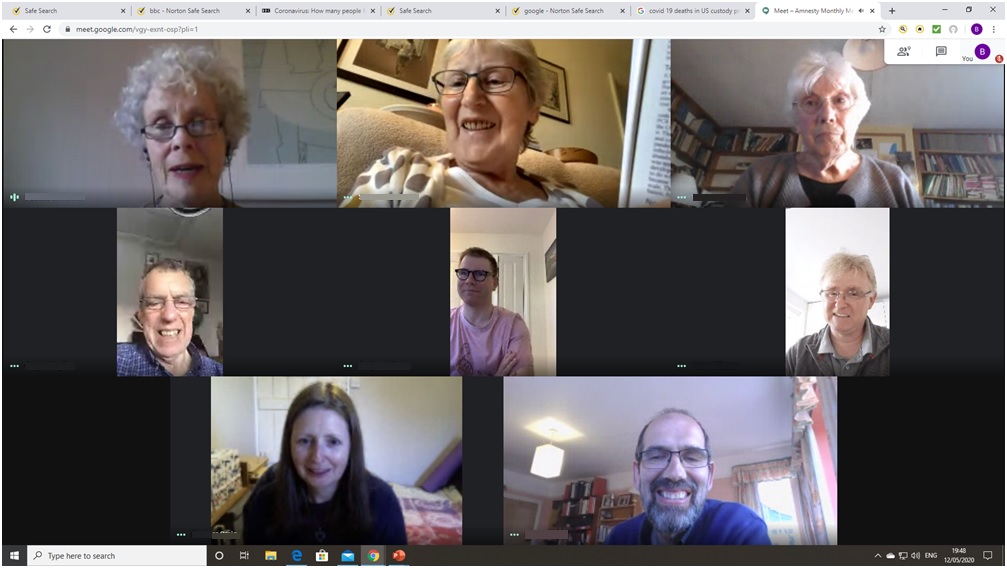 In tune with the times we held our second online virtual meeting this month, and followed up several Monthly Actions, influenced by the current crisis.
 Despite the current lockdown measures we were able to hold a virtual meeting from our own homes, and, thanks to the system set up, managed to communicate successfully.
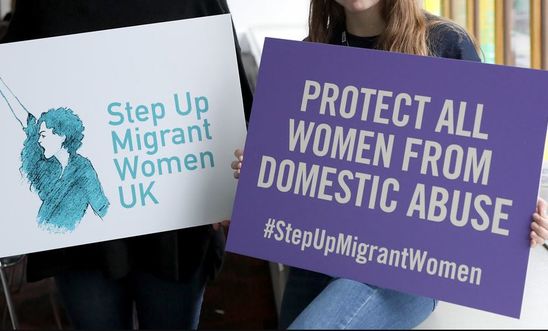 ular risk from Covid-19: women who are victims of domestic abuse, refugees and migrants, and, crucially, essential workers who need proper support and protective equipment.
 Self isolation. Funny, isn’t it, how the expression has quickly become part of our everyday language?

