

The mood of our March meeting was inevitably dominated by the conflict in Ukraine. The situation is moving so fast that the comments made by AIUK at the beginning of the month have been overtaken by further developments in this human tragedy.
Internationally AI has formally declared a Crisis Response; an Urgent Crisis Coordination Team on Ukraine has been established, with work under way on the human rights situation and refugees, but also on evidence gathering, advocacy and security planning.
The invasion of Ukraine is a clear violation of the United Nations Charter and an act of aggression under international law. When the Local Groups newsletter came out at the beginning of the month Amnesty was verifying the use of cluster munitions in a strike on a nursery; since then such acts have been repeated again and again.
The Ukraine crisis has highlighted Amnesty’s concerns with the Nationality and Borders Bill. The Government claims it will break the business model of people smugglers, but instead of targeting them, this bill targets their victims. It fails to provide safe and legal routes into the UK, meaning more and more people seeking asylum will be forced, out of desperation, into the hands of smuggling gangs.
We discussed the campaign, initiated by two of our group, for imprisoned Egyptian housing worker Ibrahim Ezz el-Din. A blitz of daily letters to officials, to him and to his family is planned for the next three months – see here for more details of how you can help.
The Government’s consultation period on planned changes to the Human Rights Act has now ended. Some members submitted their comments, and wrote to Taunton’s MP, Rebecca Pow, amid concerns that the proposed reforms will gut the Act and limit not only what rights are but who gets them.
We heard reports from our co-ordinators on North Africa, India and the Death Penalty. A letter was sent to the President of the Tunisian Republic on behalf of former Tunisian MP Yassin Ayari imprisoned in absentia for criticism of the regime.
Our Media of the Month is ‘Munich – the Edge of War’ a Netflix drama about the 1938 Munich Conference based on the novel by Robert Harris.
Meetings are now firmly back in person; the next will be on 12 April at 7.30pm at the Quaker Meeting House, Bath Place, Taunton. All welcome!



 This month’s action was for Pakistani human rights defender and researcher Muhammad Idris Khattak (pictured) who was ‘disappeared’ in November 2019. Nothing has been heard of him since, and his family is extremely concerned for his well-being – he is a diabetic needing daily medication, and at risk of course from Covid-19. The disappeared are at risk of torture and even death. If they are released, the physical and psychological scars endure. Disappearances are a tool of terror that strikes not just individuals or families, but entire societies. Enforced disappearance is a crime under international law and, if committed as part of a widespread or systematic attack, they constitute a crime against humanity. We emailed Pakistan’s Prime Minister Imran Khan on his behalf; his government promised to criminalise enforced disappearances, but nothing has been done.
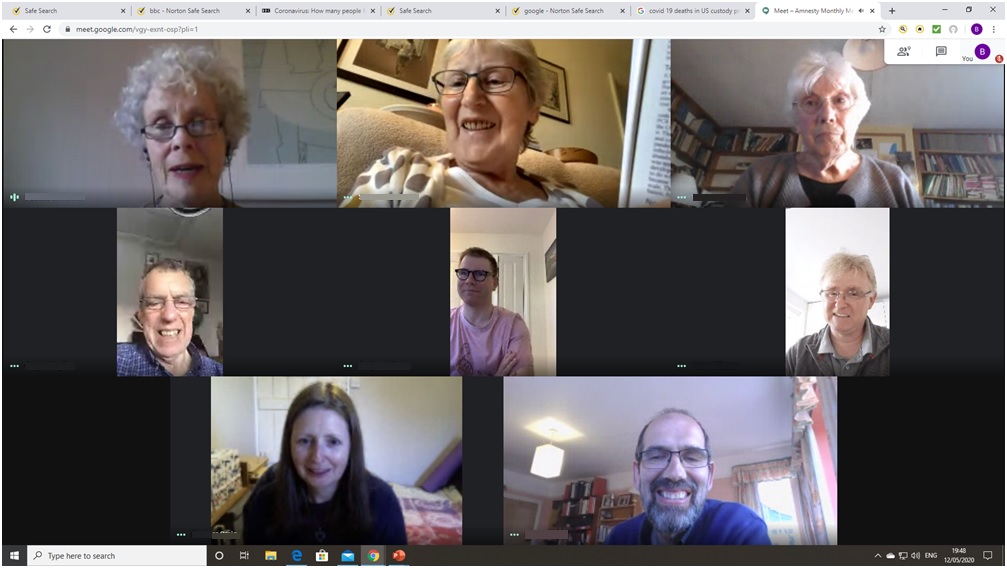 In tune with the times we held our second online virtual meeting this month, and followed up several Monthly Actions, influenced by the current crisis.
 Despite the current lockdown measures we were able to hold a virtual meeting from our own homes, and, thanks to the system set up, managed to communicate successfully.
 ular risk from Covid-19: women who are victims of domestic abuse, refugees and migrants, and, crucially, essential workers who need proper support and protective equipment.
 Amnesty International Taunton Local Group