

Human Rights are at the very core of Amnesty’s existence. Anne Walker of AIUK spoke to our online meeting this month about the Human Rights Act.
She gave a cogent account of its development from the Universal Declaration of Human Rights of 1948, a direct reaction to the horrors of WW2. In 1953 came the European Convention on Human Rights, one of the chief drafters being Sir David Maxwell Fyfe, a Nuremburg prosecutor. Stemming from this the European Court of Human Rights was set up by the ten founding members (now 47) of the Council of Europe. The UK was at the heart of its foundation.
In 1998 this was given additional force in the UK by the Human Rights Act, which places obligations on the state to respect the rights of individuals. This has had an unjustifiably bad press in the UK which has attempted to trivialise it, despite its many instances of helping the individual – for example re-enforcing the rights of elderly couples to stay together in care homes. Amnesty believes the British public needs better information on human rights and the Act.
AIUK are very concerned about proposed weakening of the Act and are committed to us remaining a signatory to the European Convention on Human Rights.
We discussed other issues: excessive confinement to the cells in UK prisons during the pandemic; continuing repression of the Uyghurs in China; and a pressure for a quicker provision of covid vaccinations for the Nepalese population.
Our Middle East co-ordinator has written to President al-Sisi of Egypt about the plight of 12 men at risk of execution because of their involvement in protests in 2013 about then President Morsi; we discussed other cases in Egypt.
Our co-ordinator on India continues to monitor the case of the BK16, a group of jailed academics and activists; a twitter storm was organised last month to rouse the Indian authorities. One of the group, Father Swamy, aged 84, has died in prison of Parkinson’s disease and covid, a direct result of the inhumane way in which the Unlawful Activities (Prevention) Act is being implemented to lock up activists without trial.
The month’s chosen media is a TV documentary, The Violence Paradox, its contention that we are – ironically – living through one of the most peaceful eras of human existence.



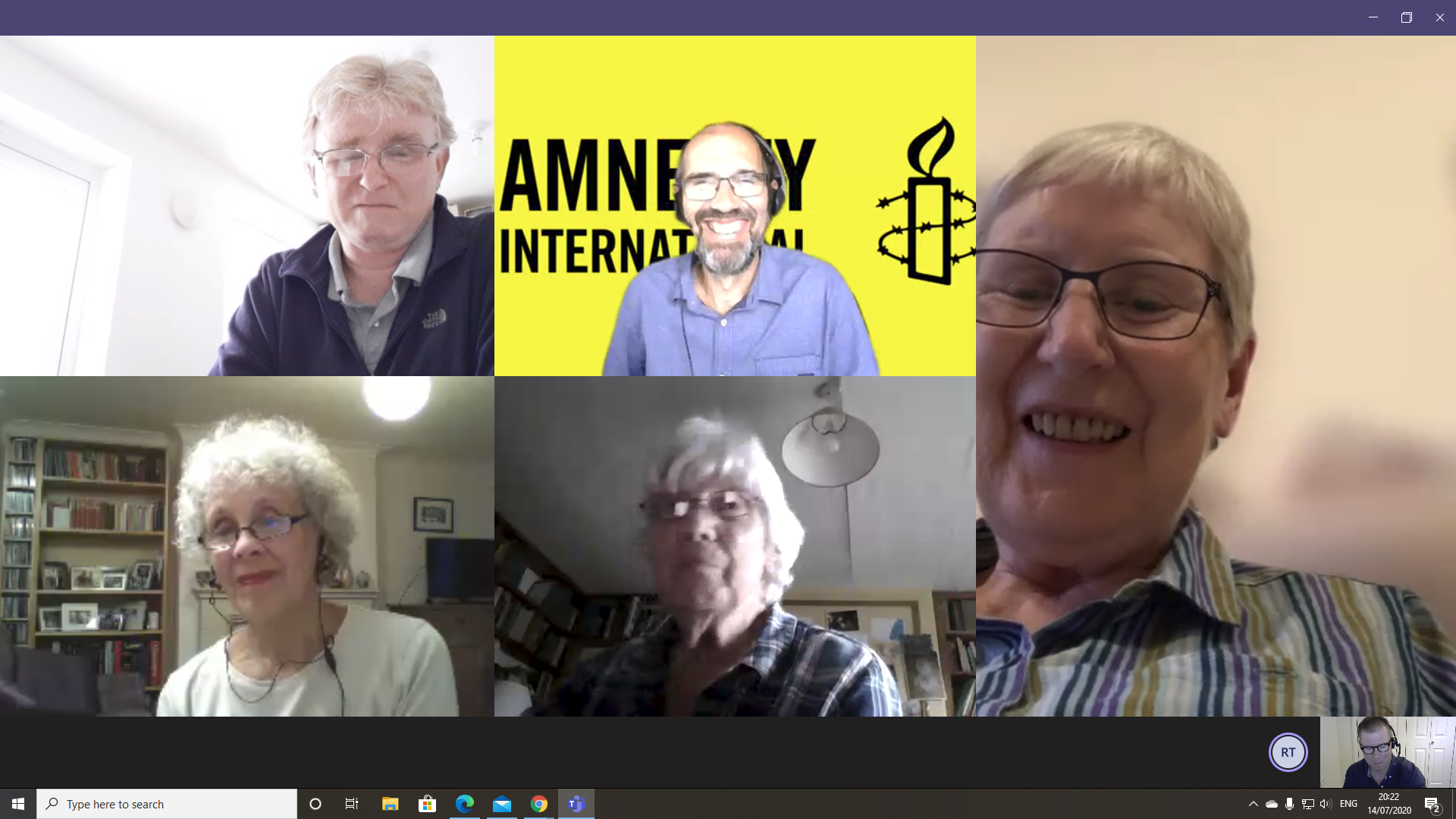 Our July meeting was held virtually – the new normal! We were joined by Helen Clarke of AIUK, Country Coordinator for Turkey, to describe her work, which is to keep abreast of all that is going on in Turkey from a Human Rights point of view and translate this into information and action.
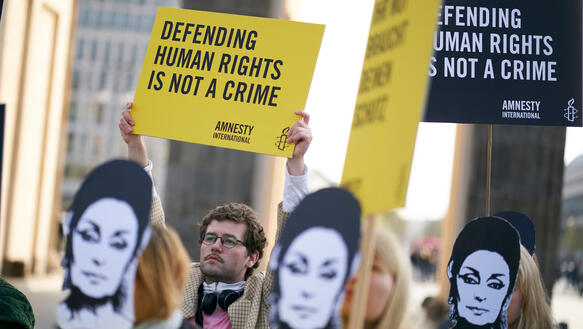
 This month’s action was for Pakistani human rights defender and researcher Muhammad Idris Khattak (pictured) who was ‘disappeared’ in November 2019. Nothing has been heard of him since, and his family is extremely concerned for his well-being – he is a diabetic needing daily medication, and at risk of course from Covid-19. The disappeared are at risk of torture and even death. If they are released, the physical and psychological scars endure. Disappearances are a tool of terror that strikes not just individuals or families, but entire societies. Enforced disappearance is a crime under international law and, if committed as part of a widespread or systematic attack, they constitute a crime against humanity. We emailed Pakistan’s Prime Minister Imran Khan on his behalf; his government promised to criminalise enforced disappearances, but nothing has been done.
 Amnesty International Taunton Local Group